
We expect many things about our bodies to change as we get older, but we don’t always think about the changes happening inside our eyes.
One structure that changes throughout our lifetime is the natural lens. Located behind the colored part of the eye, the lens plays a significant role in helping us focus and see clearly.
Understanding how the lens ages can help explain several common vision changes that occur during adulthood.
What Does the Natural Lens Do?
The natural lens works with the cornea at the front of the eye to focus light onto the retina at the back of the eye.
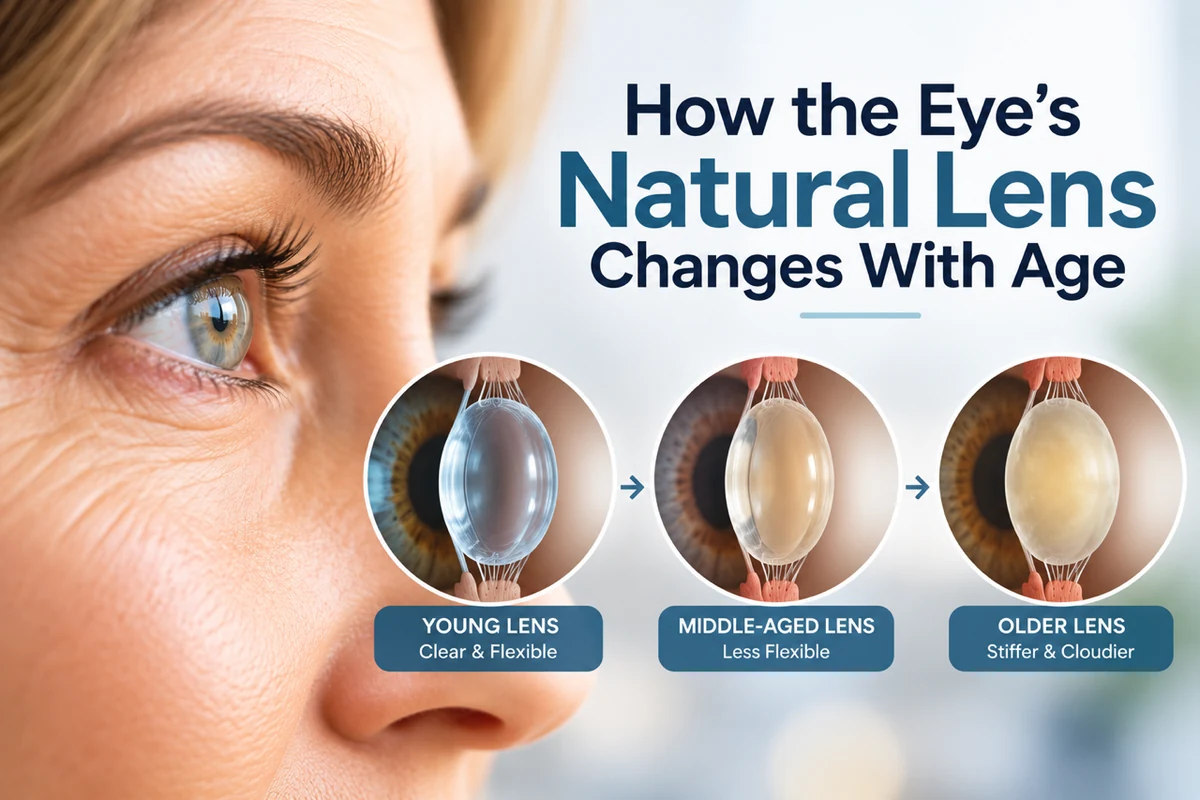
When we’re young, the lens is relatively clear and flexible. Its flexibility allows it to adjust its shape as we shift our attention between objects at different distances.
But the lens doesn’t remain exactly the same throughout life.
The Lens Gradually Becomes Less Flexible
One of the earliest age-related changes is a gradual reduction in the lens’s flexibility.
As the lens becomes less flexible, the eye has increasing difficulty adjusting its focus for close-up objects.
This is why many people begin noticing changes in their reading vision during their 40s. The age-related loss of near-focusing ability is known as presbyopia.
It doesn’t mean the eye has suddenly become unhealthy. It is a normal part of aging.
The Lens Also Changes in Clarity
Flexibility isn’t the only characteristic of the lens that changes.
Over time, proteins within the natural lens can change and begin to clump together. Eventually, these changes can make the normally clear lens increasingly cloudy.
When clouding of the natural lens begins interfering with vision, it is called a cataract.
Cataracts generally develop gradually. Early changes may include:
- Increasingly blurry or hazy vision
- Greater sensitivity to glare
- Difficulty seeing at night
- Halos around lights
- Colors appearing less vivid
- More frequent changes in a glasses prescription
Presbyopia and cataracts both involve the natural lens, but they are not the same condition.
Presbyopia primarily involves the lens losing its ability to change focus effectively for near vision. A cataract involves the lens becoming cloudy enough to interfere with vision.
Why Vision Can Continue Changing as We Age
Because the structures inside our eyes continue to change throughout adulthood, the prescription that worked perfectly several years ago may no longer provide the same vision.
Some changes may simply require an updated glasses or contact lens prescription. Others may be related to dry eye, cataracts, or another eye condition.
This is one reason regular comprehensive eye examinations are important as we age.
Healthy Aging Includes Your Eyes
Age-related changes in the natural lens happen gradually, and many are a normal part of getting older.
Knowing what’s happening inside the eye can make changes such as needing reading glasses less surprising. It can also help you understand why your vision needs may be different at 45, 55, 65, and beyond.
At North Columbus Eye Center, comprehensive eye examinations evaluate both your vision and the health of your eyes. If you’ve noticed changes in reading, night driving, glare, clarity, or your overall quality of vision, an examination can help identify what is contributing to those changes and determine the appropriate next steps.